Plan a Shared-Cooking Evening Around the Work
Plan a shared-cooking evening around guest roles, timing and hand-offs, so friends can contribute without turning dinner into a roster or leaving the host to direct.
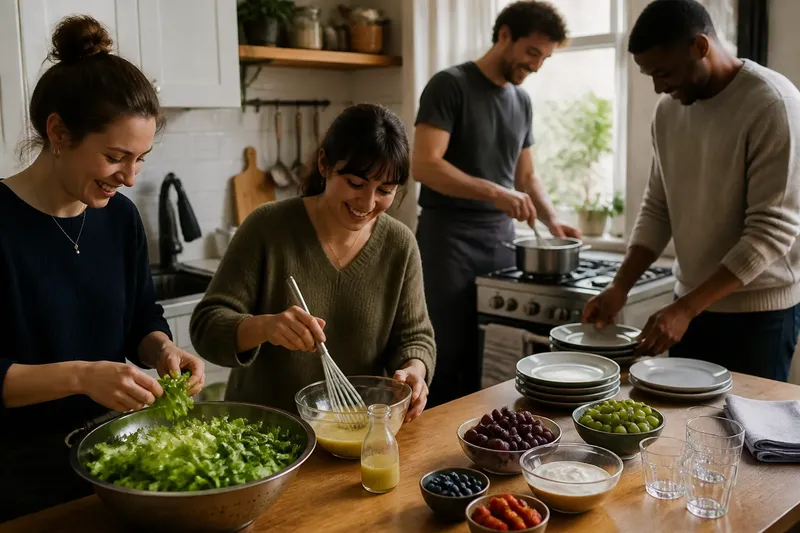
How do you plan a shared-cooking evening so friends can contribute without leaving you to direct every move? A shared-cooking evening runs more smoothly when people know what they own, when they can join, and how to hand work over.
Hosting is different from simply arranging kitchen tools: the challenge is coordinating people with different arrival times, skills and appetites for cooking. Think of the plan as a relay, not a rota. Each person should know when to take a turn and where their part goes next.
Give each guest a clear part of the meal
Plan the menu as a sequence of jobs: prepare, cook, finish and serve. Assign each part to a person, rather than asking several guests to “help with dinner”. A clear responsibility has a visible finish, such as washed herbs ready for the sauce or a salad dressed and ready to serve.
Ask guests what they enjoy and what they would rather avoid. One person may like chopping; another may prefer setting the table or assembling dessert. Make it easy to decline a job involving a sharp knife, raw meat or a hot pan, and offer another task without making a fuss.
Give each guest one main responsibility and, if useful, one optional follow-up. Explain both the result and the hand-off: “Mix the dressing, then leave it beside the salad” is clearer than “sort the salad”.
Match jobs to arrival times and attention
Some tasks can pause without trouble; others need someone nearby at a particular moment. If guests arrive at different times, reserve flexible jobs for those who may join late, such as tearing bread, washing fruit or arranging a cheese board. Keep attention-sensitive cooking with the host or a willing guest who can stay nearby.
Agree on any shared oven or hob use before cooking begins. Two dishes that need the same appliance at the same time are not separate jobs, even if different people own them. A short handwritten sequence on the fridge can show what must happen first and what can wait.
Leave breathing room between tasks. Ingredients may be missing from the plan, and conversation will interrupt the work. If timing becomes tight, choose a dish that can wait or serve a simple snack while the hot food finishes.
Choose jobs that fit the room and the group
In a compact kitchen, let fewer people handle active cooking at once. Move suitable, lower-risk tasks to a dining table or another safe area: setting plates, stripping herbs or mixing a dressing, for example. In a larger kitchen, guests can take separate meal components, provided you have agreed how those parts come together.
For someone new to cooking, choose a bounded task with an obvious finish, such as measuring spices into a bowl or arranging fruit on a plate. Show where the finished item should go, then let them work at their own pace. Avoid vague instructions that require them to keep asking what comes next.
Ask about allergies and dietary needs in advance. Keep ingredients and utensils distinct where needed, and check product labels or seek qualified advice if you are unsure how to accommodate a serious allergy.
What should you agree before anyone starts?
How many guests should cook at once?
Base the decision on how many people can work safely without interfering with each other, not on the number invited. In a narrow kitchen, rotate short tasks and move suitable preparation to another space.
Which tasks suit a guest who rarely cooks?
Offer a task with a clear endpoint and little coordination, such as washing fruit or setting out plates. Explain where the tools are and where the finished work belongs.
Should guests bring ingredients?
Ask for a specific item only after checking that it fits the menu and the meal’s storage and cooking needs. A named contribution, such as a loaf of bread, is easier to plan around than several surprise dishes.
What should happen if the meal runs late?
Tell guests plainly what is delayed and choose whether a ready part of the meal can be served first. Keep the person handling hot food free to focus rather than giving them extra hosting duties.
Check the plan against what guests will actually encounter
Before guests arrive, use these checks to spot coordination problems and choose an alternative while there is still time to adjust.
- Observation: Two dishes need the oven at the same time. If both cannot cook as planned, then change the cooking order or choose a dish that does not need the oven.
- Observation: A guest will arrive after the main preparation starts. If their assigned job cannot be paused, then give it to an earlier arrival and reserve a flexible task for the late guest.
- Observation: A guest is unsure about using a knife. If the task needs knife skills they do not want to use, then offer a no-knife job such as washing leaves or setting plates.
- Observation: One person has several jobs that need attention at serving time. If those jobs overlap, then transfer one task to another willing guest or simplify the meal.
- Observation: A guest has a dietary restriction or allergy. If the planned ingredients or utensils may create a problem, then confirm suitable alternatives in advance or change the dish.
- Observation: Guests do not know where their finished work should go. If the hand-off is unclear, then name a place and recipient, or keep the task with the person who will serve it.
A worked plan keeps the host in the evening
Imagine you are hosting three friends in a narrow kitchen for pasta, green salad and fruit with yoghurt. You make the sauce before they arrive and wash the salad leaves. You decide that the hob needs your attention, so you keep the pasta and sauce. One friend mixes the dressing at the dining table, another tears the leaves, and the third sets out plates and washes the fruit.
When the salad is ready, the second friend hands it to the person mixing the dressing, who combines them and takes the bowl to the table. The third friend puts the fruit beside the yoghurt. If one guest arrives late, you give them the finished, self-contained fruit task rather than interrupting the pasta. The result is a set of clear hand-offs, with fewer reasons for anyone to stop and ask what comes next.
Keep the plan flexible once cooking begins
A plan should help the group adapt, not trap anyone in a role. If someone wants to switch tasks, check that the timing and responsibility still make sense. If the kitchen becomes crowded, pause one person’s task or move suitable work elsewhere rather than asking everyone to squeeze in.
The best plan for a shared-cooking evening is specific about ownership and relaxed about the small changes that follow. Agree on the hand-offs, leave flexible jobs for late arrivals, and make sure each guest can see what “finished” means. Then you can spend less time directing the room and more time enjoying the people in it.