Wood, Plastic or Silicone: Choosing a Spatula for the Job
Choose a spatula by matching its material to heat, flexibility, pan contact and cleaning needs, so the right tool handles each kitchen task with less fuss.
Which spatula should you reach for when a pan is hot, a bowl is sticky or a delicate piece of fish needs turning? Choosing a spatula starts with the job, not the material’s reputation. Wood, plastic and silicone each behave differently against heat, food and cookware, so a quick check of the task can narrow the choice.
Think of the blade as a small door sweep: a flexible edge can follow a curve, while a firmer one keeps its shape under pressure. The handle, head shape and construction matter too. Work through these decisions in order, then keep the tools that earn a clear place in your cooking.
Start with the food and the movement
First, name the action. Are you scraping batter from a mixing bowl, folding egg whites, turning a pancake, stirring a sauce or lifting a piece of food from a pan? “Spatula” covers several shapes, and a material cannot make the wrong shape suitable.
- Scraping and folding: A broad, flexible blade that bends along a bowl’s curve gathers soft mixtures and can fold them without a sharp, chopping motion.
- Stirring and mixing: A sturdy, narrower tool is easier to control in a saucepan or mixing bowl, especially when the mixture thickens.
- Turning and lifting: A turner has a flatter, wider head. Its leading edge needs to slide under food; a narrow, floppy scraper may buckle instead.
- Serving: Choose a head with enough support and a shape that fits the dish. A slotted turner can let liquid drain, while a solid head can carry soft food with its sauce.
Now consider the food’s texture. A thick dough asks more of a blade than a loose cake batter. A fragile omelette calls for a different edge from a tray of roasted vegetables. The aim is controlled contact, not a tool that tries to do every job.
Match flexibility to the shape of the vessel
Flexibility determines how closely the blade can follow the surface and how much force it can transfer. A thin, yielding edge can sweep around a rounded bowl and get beneath a tender mixture. A firmer blade is better for pushing, turning or scraping when the food resists.
Silicone spatulas are often available with flexible heads suited to bowls and soft mixtures. Check the edge rather than assuming all silicone tools bend alike: some have a pliant perimeter with a reinforced centre, while others feel soft throughout. A stiff core can help the head hold its shape; a very yielding blade may fold instead of lifting a dense mixture.
Wooden spatulas tend to keep a solid shape, making them useful for stirring and scraping in a pot. Their broad, blunt edges can move ingredients without the spring of a thin scraper. Plastic turners also come in a range of stiffnesses, from slim heads for gentle lifting to sturdier shapes for heavier food.
Look at the vessel’s corners and curves. A rounded bowl benefits from an edge that can bend around its side. A flat frying pan calls for a head with a low, thin front edge that can slip beneath food. For a deep pot, a longer handle can keep your hand farther from rising steam while still letting you reach the base.
Check heat suitability before using the tool
For cooking in a hot pan, confirm that the spatula is intended for that use and follow the product’s stated heat limits. Silicone is commonly sold for hot-pan use, but its rating varies by product. Plastic tools may be intended for lower-temperature tasks or brief contact, and some can soften or deform if left against a hot surface.
Wood does not melt, but it can darken, dry or scorch if left against a hot pan or flame. No material should be left resting on a hot surface while you turn away. If a tool becomes discoloured, warped, cracked or unusually rough, stop using it for that task and check the maker’s care guidance.
Also consider the pan coating. For non-stick cookware, use a utensil described as suitable for that surface, and avoid a sharp or damaged edge that could scratch it. Wooden and silicone heads are often chosen for coated pans, but construction and condition still matter. A metal insert, seam or worn corner can change how a tool meets the pan.
Choose an edge that makes proper contact
Surface contact is easiest to judge by watching the leading edge meet the vessel. For a bowl, the edge should lie close enough to collect mixture rather than leave a thick band behind. For a pan, it should slide under the food without digging into the cooking surface or bending out of control.
A silicone scraper’s soft edge can conform to curves, which is useful when collecting mayonnaise, cake batter or a sauce from a bowl. Its flexibility can also help it sweep a pan gently, provided the head is designed for that heat and task. A blunt wooden edge is less likely to make a close seal against a rounded bowl, but its firmness can be helpful for moving food around a pot.
Plastic turners often have a thin front edge that can slip beneath pancakes or fish. Their performance depends on the shape and thickness of the head: a broad, stiff turner supports food, while a thin one may flex too far under a heavy portion. If you use coated cookware, inspect the edge for burrs or damage before putting it to work.
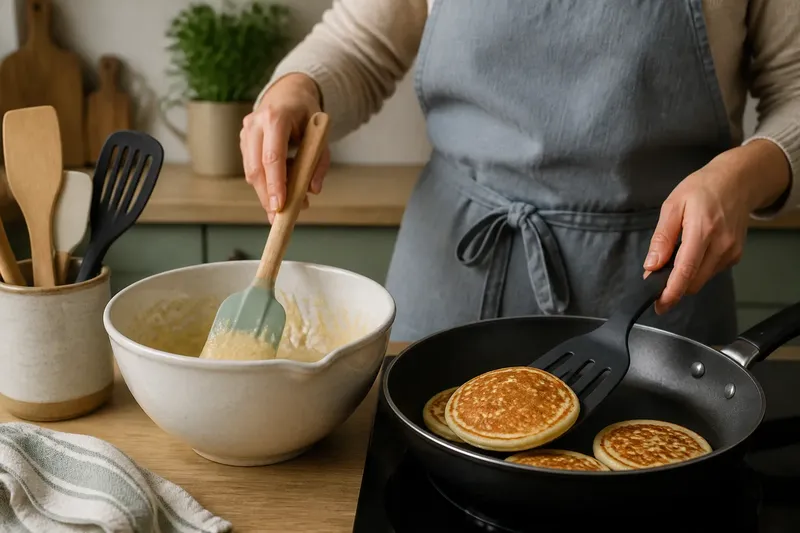
Say you are making a thick pancake batter in a ceramic bowl and then turning pancakes in a non-stick pan. An invented, practical pairing would be a flexible silicone scraper for clearing the bowl, followed by a pan-safe plastic turner with a thin front edge for lifting. The expected observable result is that less batter clings to the bowl and the turner can get beneath each pancake without forcing its head down against the coating.
Weigh cleaning and construction
Cleaning is not an afterthought; it affects whether a tool is ready for its next task. A one-piece silicone spatula has no handle joint for food to lodge in, and many products can go in a dishwasher if their care label says so. Some silicone heads are removable, which makes the underside of the head easier to inspect and wash.
Wood needs a gentler routine. Wash it promptly by hand, dry it thoroughly and avoid leaving it submerged, since prolonged soaking can encourage splitting or roughness. A wooden handle joined to a separate head deserves a close look: residue can collect at the connection, and the joint should remain secure.
Plastic utensils are often straightforward to wash, but check their dishwasher suitability and inspect for warping, deep scratches or a rough edge. Scratches can hold residue and make a utensil less pleasant to clean. If the head is bonded to the handle, look for gaps or movement at the join.
Product labels and manufacturer instructions determine heat limits, cookware compatibility and cleaning method, so check those details when the tool’s intended use is unclear. Material names alone do not settle every question; a reinforced silicone head, for instance, behaves differently from a soft, unsupported one.
Which spatula suits the task you have?
Which spatula is best for scraping a mixing bowl?
Choose a flexible silicone scraper with an edge shaped to follow the bowl’s curve. If the mixture is unusually thick, look for a reinforced head that can push without folding over.
Can a plastic spatula be used in a hot pan?
Only use it for hot-pan cooking if the product is explicitly intended for that heat and its stated limits suit the task. If that information is missing, reserve the utensil for cooler food preparation rather than guessing.
Is wood suitable for a non-stick pan?
A smooth wooden spatula can be a gentle option for coated cookware, but inspect it for splinters, rough patches and damaged edges. Keep it clean and dry between uses so its surface remains in good condition.
What is the difference between a scraper and a turner?
A scraper usually has a flexible head for collecting or folding mixtures in a bowl. A turner has a flatter, broader blade designed to slide beneath food and lift it from a pan or tray.
Keep a small, task-led selection
You do not need a drawer full of near-identical tools. A flexible scraper for bowls, a heat-suitable stirring spatula for pots and a thin-edged turner for lifting cover distinct actions. If your cooking rarely involves one of them, there is no need to keep that type just because it is sold as a kitchen staple.
When choosing a spatula, test the unheated tool in the vessel it will serve: check whether the edge reaches the curve, whether the head bends under light pressure and whether the handle gives a comfortable grip. Then confirm its care and heat guidance before using it in a hot pan. That small sequence ties material to the actual job, rather than asking one spatula to be a scraper, stirrer and turner all at once.