The Knife Edge: Why Shape Matters More Than a Single Number
Knife edge shape affects how a blade meets food, moves through it and feels in hand, helping you choose a kitchen knife for the cuts you make.
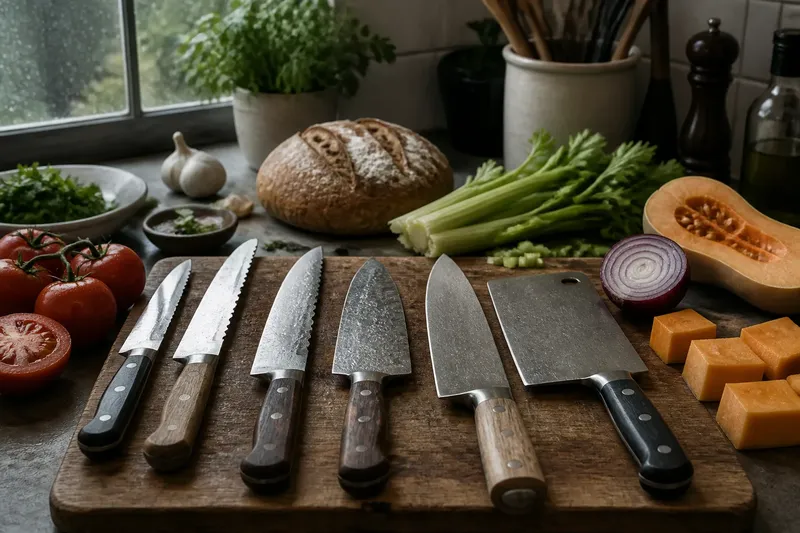
Why can one kitchen knife glide through a ripe tomato while another crushes it, even when both seem sharp? Knife edge shape is part of the answer: the blade’s curve, thickness and bevel determine how it meets food, while the food itself determines which qualities matter. A single angle or sharpness rating cannot describe that whole encounter.
Look beyond the edge’s narrow point. These five features explain why knives feel different at the board and what each shape is suited to cut.
1. The blade’s curve decides how it travels
Lay a chef’s knife on a board and look at its cutting edge from the side. Some edges rise in a pronounced curve towards the tip; others stay flatter for much of their length. That curve changes the motion a knife naturally invites.
A curved edge supports a rocking cut: the tip can remain near the board as the heel lifts and falls. It suits chopping herbs or making repeated cuts through ingredients that yield readily. A flatter edge, common on some Japanese-style chef’s knives, can keep more of the blade in contact with the board during a straight downward cut. It may feel at home when slicing vegetables with a push-cutting motion.
Neither shape makes one knife universally better. If your usual motion is a firm vertical chop, a pronounced belly may mean that only part of the edge meets the board at once. If you rock the blade, a flat profile may feel less fluid. The useful question is not which outline is superior, but which one matches the motion your hand already makes comfortably.
2. Thickness behind the edge affects resistance
The edge is only the start of the blade’s geometry. The metal just above it can taper gradually or remain relatively thick. That difference affects how the knife moves through dense food once the edge has begun to cut.
A thin blade can pass through a carrot or potato with less wedging, because it parts the cut surfaces without forcing them widely apart. A thicker blade may feel sturdy in the hand, yet it can push those surfaces aside and create more resistance. For delicate slicing, that wedging can also leave fragile pieces split or ragged.
Think of a knife entering a cut like a doorstop moving into a narrow gap: the wider it becomes, the more it pushes the sides apart. This is why two edges with similar sharpness can behave quite differently in a dense ingredient. The steel’s thickness and its taper matter after the first contact, not just the very tip.
3. Bevel shape changes the feel of a cut
The bevel is the sloping surface that narrows the blade towards its edge. A symmetrical bevel descends from both faces; an asymmetrical bevel favours one side. Some specialist knives have a pronounced single-sided grind, while many general-purpose kitchen knives are ground on both sides.
A symmetrical edge tends to suit a range of hand positions and cutting directions. An asymmetrical edge can encourage a particular cutting path and may suit a cook who consistently works in one orientation. It can also cause the blade to drift slightly towards one side of a cut, depending on the bevel and the pressure applied.
That distinction is easy to notice when slicing a firm ingredient. If a knife repeatedly steers away from the line you intend, the grind may be one reason; hand position and technique also matter. Check which side the bevel favours before choosing a knife for a shared kitchen, especially if different cooks use different hands or cutting motions.
4. Food texture changes what an edge needs to do
Soft, slippery and tough foods place different demands on the blade. A ripe tomato has a taut skin over tender flesh. A smooth edge can start a clean cut, but if it presses too hard before biting, the skin may skid and the flesh may collapse. A fine serrated edge can catch that skin with less downward force.
A crusty loaf presents another surface problem. Its crisp exterior resists a smooth edge, while its soft interior can flatten under pressure. Bread knives use teeth to engage the crust as the blade moves back and forth, helping the cut progress without asking the cook to press down heavily.
Fibrous ingredients, such as celery, can catch against a dull-feeling or rough cut. A clean, continuous edge is often useful there, while a large toothed edge may snag rather than make a neat slice. For hard squash, the challenge is different again: the blade must meet a resistant surface, and its thickness can affect how strongly the ingredient is pushed apart. The food’s texture is as important as its name when choosing an edge.
5. Point, heel and tip serve different tasks
A knife is not one uniform cutting surface. The heel, the broad rear portion near the handle, can apply force through a dense ingredient. The middle of the blade handles many ordinary slices. The tip offers control for smaller, more precise work, such as trimming a strawberry or removing a blemish.
On a chef’s knife, the tip’s curve and the blade’s height help determine whether it feels nimble or broad. A compact paring knife gives close control for work held in the hand, while a long slicing knife can draw through a large cooked joint in a smooth stroke. A cleaver’s broad, weighty form is designed for particular chopping tasks, but it is not a substitute for a thin slicer when the aim is neat, delicate portions.
Match the part of the blade to the job. Using the tip for a forceful cut through a dense vegetable can feel unstable; trying to make a fine trim with the heel can feel clumsy. The shape helps distribute control and force along the length of the knife.
6. Edge geometry and steel are separate considerations
People often compare knives by steel type, hardness or a stated edge angle. Those details can matter, but they do not tell the whole story. Steel describes the blade material; geometry describes the blade’s shape and how it narrows towards the edge. A hard steel can hold an edge well yet still feel thick through a cut. A different steel may be easier to maintain but have a geometry that suits a particular food more closely.
Edge angle is also only one part of the bevel. The angle can influence how fine or robust the very edge is, but it says little by itself about the blade’s overall thickness, curve or grind. Treat a single number as a narrow description, not a full prediction of performance.
Say you are choosing between two knives for frequent vegetable preparation. One has a very acute edge but a thick body behind it; the other has a slightly broader edge and a thinner taper. For dense carrots, the second may feel less wedge-like, while the first may make a keen initial bite. The observable difference is how each moves through the food, not which number looks more impressive on a label.
7. Which knife shape suits your regular cuts?
Is a curved chef’s knife better for rocking cuts?
A curved belly supports rocking because the blade can pivot around its tip. It suits cooks who chop herbs and other ingredients with that motion, though comfort depends on the knife’s full profile and the way it fits the hand.
Does a thin edge always cut better?
A thin blade can reduce wedging in dense ingredients, but thinness alone does not make a knife right for every task. A more robust profile may feel steadier for heavier work, while a delicate blade may call for more careful use.
Why does a knife crush ripe tomatoes?
The edge may be pressing into the skin before it catches, or the blade may be dull enough to require extra force. A fine serrated tomato knife is designed to grip the skin and begin the cut with less downward pressure.
Does a one-sided bevel suit every cook?
No. Its cutting path may feel natural for one hand and awkward for another, and the blade can steer to one side. A symmetrical grind is often a more adaptable choice when several people share the knife.
Choose by the cut you make, not one number
When comparing knives, look at the curve from the side, the taper behind the edge and whether the bevel is symmetrical. Then consider the food you cut most often and whether your usual motion rocks, pushes or draws the blade. A knife that suits those decisions is likely to feel more predictable than one selected by a headline specification alone.
For a first comparison, slice a soft tomato and a firm carrot with the same comfortable motion, using a stable board and an appropriately sharp knife. Notice whether the edge catches the tomato skin, whether the blade parts the carrot cleanly and whether the handle lets you guide the cut without strain. Those observations make knife edge shape easier to understand—and give you a more useful basis for choosing than a number in isolation.