Why More Countertop Gear Can Slow Dinner Down
Why more countertop gear can slow dinner down: learn how a meal-specific appliance audit frees the surface needed to prepare food without clutter.
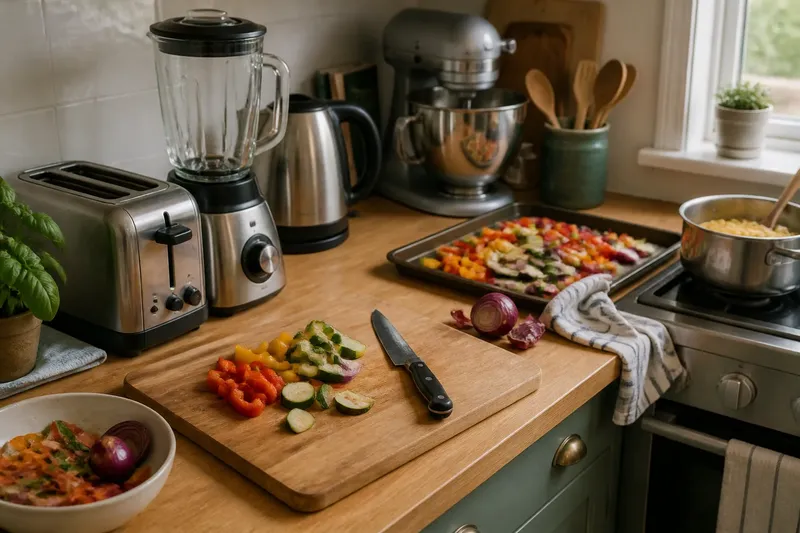
Why more countertop gear can slow dinner down becomes clear when the recipe calls for a chopping board, but the only open patch is occupied by a blender. The issue is not simply a crowded worktop; it is that appliances designed for particular jobs can quietly become permanent residents, even when the meal needs a different kind of space.
Imagine you are preparing roasted vegetables and pasta, with a toaster, blender, kettle and stand mixer on the counter. In this invented situation, the useful question is not where to put every tool during cooking. It is which appliances have earned a place on the worktop between meals, and which belong in a cupboard until their job comes round.
Countertop gear slows dinner down when storage habits go unexamined
Kitchen appliances often settle into their positions through habit. The toaster stays out because it is used at breakfast; the blender remains beside it because it was convenient once; a mixer occupies a broad patch simply because there is no obvious alternative. Over time, the counter can become a record of past decisions rather than a surface arranged for the next meal.
That distinction matters. A worktop is not a display shelf, and an appliance’s usefulness does not depend on being visible. A corded machine can be ready for use in a cupboard, while a clear surface can support several ordinary tasks without requiring a specialist tool.
Separate everyday access from permanent counter space
Think of counter space like a coat hook: keeping one item handy is sensible, but filling every hook leaves nowhere for the coat you need now. For appliances, decide on a home based on how often they are used, how awkward they are to move, and whether their current position interrupts other work.
- Observe whether the appliance is used for most meals; if so, keep it out only if it leaves the main preparation surface free, otherwise move it to an accessible cupboard.
- Observe whether the appliance is bulky or heavy to lift; if so, store it on a reachable low shelf, otherwise use a higher cupboard or drawer suited to its shape.
- Observe whether its cord crosses a food-preparation area; if so, relocate the appliance or secure its cord away from the work zone, otherwise retain its position if the surface remains clear.
- Observe whether the machine is needed for the meal being prepared; if not, return it to storage, otherwise place it where its use will not displace the board or ingredients.
- Observe whether moving the appliance creates a stable, usable patch of counter; if so, leave that patch available for food preparation, otherwise choose a different storage spot and reassess the layout.
- Observe whether the appliance is used by more than one person in the household; if so, agree on a shared storage home, otherwise choose the most convenient safe place for its regular user.
These checks are not a command to hide every appliance. They help distinguish a tool that earns its place through regular use from one that has simply never been moved. Keep a frequently used machine out if it fits without taking over the area needed for food preparation.
A small audit can reveal which appliance is in the way
Try an appliance audit before rearranging the whole kitchen. Start with the tools already on the counter and make a short note of each one’s last use, its storage location and whether it blocks the work surface you need. Then move only the item that conflicts with the next meal, rather than emptying cupboards or buying organisers.
Say you plan to make roasted vegetables and pasta, and the blender sits beside the sink while the toaster and kettle occupy the other clear patch. You need a board, a bowl for scraps and a tray for cut vegetables. You move the blender to its cupboard, check that the board can sit flat and that its cord is out of the way, then set the bowl and tray within reach. The resulting decision is straightforward: if those items fit and washing, chopping and collecting can proceed without shifting another appliance, the blender’s counter position was unnecessary for this meal; if they do not fit, choose another appliance to store or use a different preparation surface.
The point of the example is the decision process, not a claim that every kitchen has the same layout. Appliance size, cupboard access and the meal itself will change what makes sense.
Which countertop appliances deserve a permanent place?
Should frequently used appliances remain on the counter?
They can stay out if they do not block the surface needed for food preparation or create a cord snag. If they do compete for that space, an accessible cupboard may be the better home.
Where should bulky or heavy appliances go?
Choose storage that is reachable without awkward lifting, such as a low shelf or a cupboard near the place where the appliance is used. If moving it safely is difficult, ask another household member for help or reconsider whether it should remain out.
What belongs on the worktop during meal preparation?
Keep only the tools and ingredients needed for the current task, with room for a board and somewhere to collect prepared food. Return unrelated appliances to storage if they occupy that working area.
How can you tell whether an appliance is in the wrong place?
Notice whether you repeatedly move it to make room for a board, bowl or ingredients. If that happens, try another storage position and keep the change only if it leaves the counter more usable.
Make the counter fit the meal, not the appliance collection
Before cooking, identify which appliance the recipe actually needs and which part of the counter must remain open. Put away equipment that has no role in that meal, while keeping genuinely useful tools accessible in a safe place. Afterward, return appliances to their agreed homes rather than letting each one claim the nearest patch of worktop.
Why more countertop gear can slow dinner down is ultimately about the difference between access and availability. An appliance can remain easy to reach without occupying the surface where food needs to be prepared. A brief, meal-specific appliance audit makes that distinction visible and helps the worktop serve the cooking rather than the storage habit.